Why the next five years could have a lasting impact on Queensland apartment owners?
If you own an apartment or townhouse in a body corporate, there’s a conversation your committee should already be having.
Over the next decade, thousands of apartment buildings across South East Queensland are expected to reach the stage where major building components—including roofs, waterproofing, lifts, concrete, façades and fire safety systems—require significant repair or replacement.
On its own, that’s not unusual. Every building needs major maintenance as it ages.
What makes the next decade different is that many of Queensland’s apartment buildings are reaching this point at the same time. Combined with rising construction costs, labour shortages and the Brisbane 2032 Olympic Games, demand for specialist building contractors is expected to increase significantly.
For owners, the decisions made today could influence future levies, property values and the long-term condition of their building.
Why is this happening?
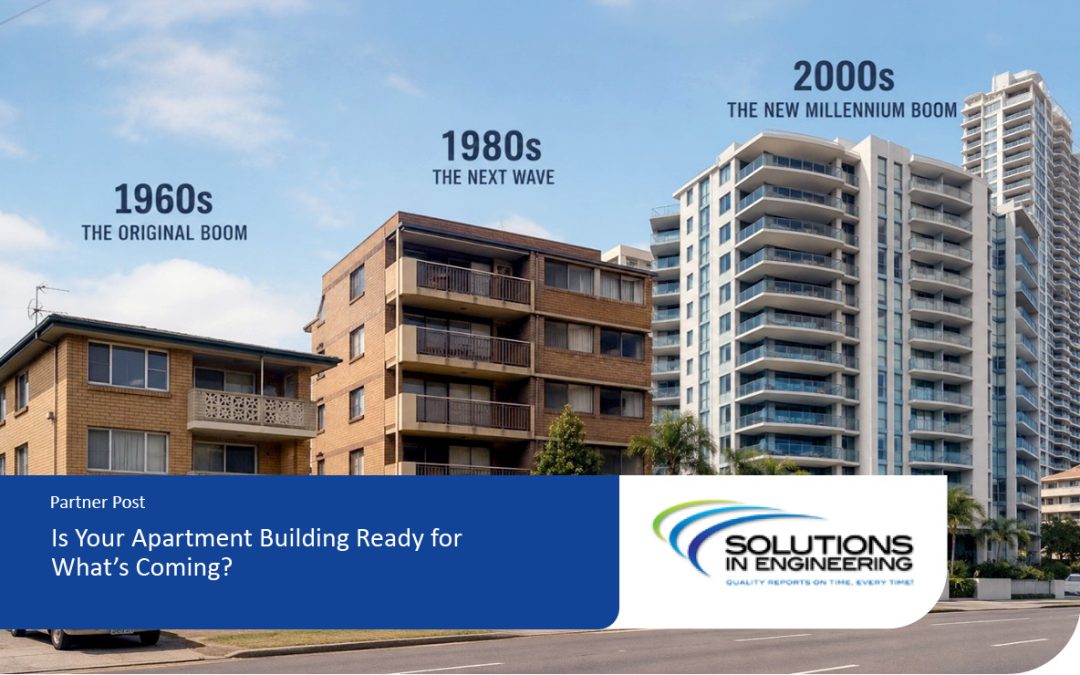
Queensland experienced several major apartment construction booms during the 1960s, 1980s and early 2000s.
Each generation of buildings was constructed using different materials, building methods and technologies, but many are now approaching the point where expensive building components reach the end of their useful life.
Older buildings are naturally ageing, while some newer apartment buildings are experiencing earlier-than-expected maintenance issues due to increasingly complex building systems and, in some cases, construction defects.
Rather than a steady flow of maintenance across the industry, these different generations of buildings are converging into one large wave of demand.
A $20 billion maintenance challenge
Australia’s strata sector has an estimated replacement value of around $1.4 trillion, with almost half of all strata schemes registered before 2000. Research estimates the ageing strata building stock across South East Queensland represents approximately $130–145 billion in replacement value. Industry benchmarks suggest that major end-of-life remediation typically costs around 15% of a building’s replacement value, resulting in an estimated $20 billion in capital works over the next decade.
That doesn’t mean buildings are being rebuilt.
It means many will require major investment in replacing ageing building elements, including:
- Roofs and waterproofing systems
- Concrete and façade repairs
- Lift replacement and upgrades
- Fire safety systems
- Essential building services
These projects are often the largest expenses a body corporate will face.
Waiting usually costs more
One of the biggest misconceptions is that delaying maintenance saves money.
In reality, building problems often become more expensive the longer they are left unresolved.
A small waterproofing issue today can eventually lead to concrete deterioration, structural repairs and internal damage affecting multiple lots.
Industry specialists estimate that delaying preventative maintenance can increase remediation costs by up to four times compared with addressing issues early.
For owners, this can mean larger special levies and more disruptive repair projects.
What does this mean for owners?
While owners aren’t expected to become building experts, it’s important to understand whether your body corporate is planning ahead.
Some questions worth asking at your next Annual General Meeting include:
- Does our sinking fund forecast reflect today’s construction costs?
- Have we identified the major building components likely to require replacement over the next 10 to 15 years?
- Is our committee addressing maintenance issues before they become major repairs?
- Has our building’s insurance replacement value been reviewed recently?
- Are we building sufficient funds to reduce the likelihood of large special levies?
Planning ahead won’t eliminate future maintenance costs, but it can help spread those costs over time and reduce financial surprises.
Looking ahead
Every building reaches the point where significant maintenance becomes necessary. That’s a normal part of owning property.
The challenge facing Queensland is that many apartment buildings are expected to reach this stage simultaneously, placing increased demand on contractors, materials and specialist trades.
The buildings that are likely to navigate the next decade most successfully won’t necessarily be the newest. They’ll be the ones where committees have planned ahead, maintained their buildings proactively and built realistic sinking funds for the future.
For owners, taking an interest in your building’s long-term maintenance strategy today could make a significant difference to your property’s future value and the levies you’ll pay tomorrow.