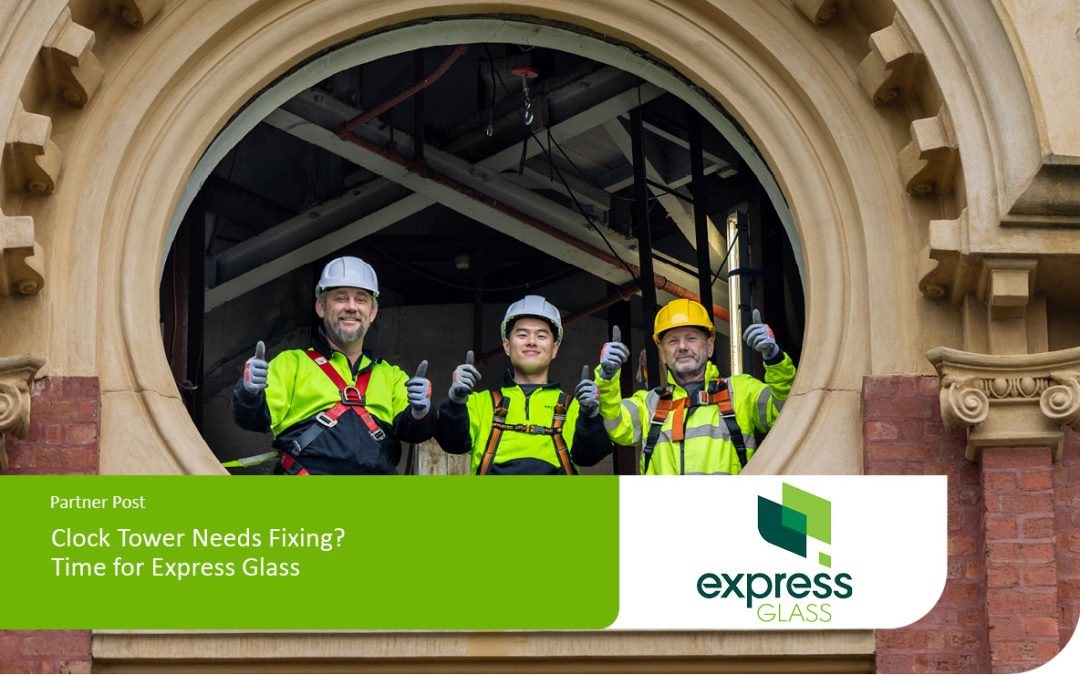
When clock faces on Melbourne’s iconic Dimmeys Clock Tower needed replacing, the glazing experts at Express Glass stepped in to restore a beloved landmark to its former glory
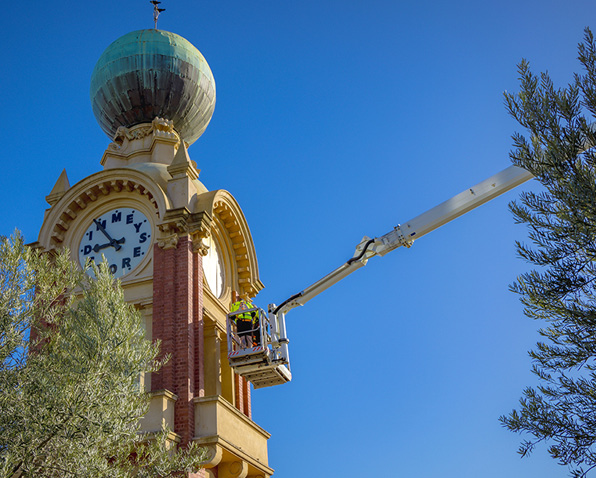
Mention the words ‘clock tower’ to people, and they’re likely to immediately think of the one that gets struck by lightning in classic ’80s flick Back to the Future. Mention ‘clock tower’ to a Melburnian, however, and the (second) thing they’ll likely think of is Dimmeys clock tower on Swan Street in Richmond, a beloved local landmark that was built in 1910 as an extension to popular drapery store Dimmeys.
The clock tower, which was painted yellow and black in 1981 to mark the 350th AFL game of Richmond footballer Kevin Bartlett, hasn’t been struck by lightning, but it has seen some wear and tear over the years, as you’d expect for an icon whose age is north of a hundred.
The problem? A shattered clock face on the eastern side, and a second clock face on the southern side with a hairline crack, putting it at risk of shattering in the future. The solution? A meticulous clock face replacement plan to be executed by glazing experts Express Glass, the best in the biz when it comes to glazing solutions for both small projects and those that are more clock-tower sized.
For a clock-related job with a lot of moving parts (terrible pun intended), the Express Glass team had a multitude of ducks to get in a row, starting with sourcing the glass for the clock faces – a tricky task when the originals weren’t exactly perfect circles.
“The challenge was getting them cut to be the correct circumference, because the sandstone holes that housed the original clock faces were not exactly round,” says Joe Cunningham, the Express Glass Project Manager who oversaw the job. “We had to build a template of both faces to ensure that when we went to cut the glass, that it was cut correctly to size.”
The clock faces couldn’t just be cut anywhere, either: due to the size (diameter: 2230mm) and weight (146.46 kg each) of the clock faces, and the fact that they needed to have a hole drilled in the middle of the double-laminated glass by a CNC machine, the job was handled by Australian Glass Group in Hobart, Tasmania, the only place in Australia that could work to the precise specs in-house.
Think it’s then a simple case of just chucking the custom-made clock faces into place, and Bob’s your mother’s brother? Think again.
“The job itself wasn’t difficult, it just had a lot of steps to consider,” says Express Glass Managing Director Adrian Grocott. “The clock tower was in the middle of the Dimmeys building – so back from a busy road, which you had trams running along on overhead live wires. Closing the road off wasn’t an option, so we had to position a pretty large crane in a side street to lift the glass up to the tower.”
The next issue to figure out? Installing the clock faces from inside the tower, since they were too big to slide through the sandstone holes from the outside.
“The clock tower has three levels: Level 1 is a residential unit [Fun fact #1: The Dimmeys building now houses 82 apartments], Level 2 is an empty room with windows [Fun fact #2: Back in the day, Dimmeys would get a band to play in here], and Level 3 is where the clock mechanism – which makes you feel like an ant inside a wristwatch – lives in a very confined space,” explains Adrian.
“We had to remove the windows on Level 2 and crane in the clock faces. There was a small manhole and ladder in that room leading up to Level 3, so there was no way the clock faces were going through that. [Fun fact #3: On average, men and women were 10cm shorter 100 years ago compared to now, which explains why the space was so tight.] Instead, we had to cut a slot into the timber roof and winch the clock faces up to Level 3.”
If you’re thinking, “Surely you’d need permission to cut holes into a heritage-listed building?!”, you’d be bang on. Enter architect and ‘Heritage Consultant’ Gosia Gabrys, who acted as the liaison between Express Glass and state government organisation Heritage Victoria.
“I am the conservation and heritage architect for the Dimmeys site, which I regularly visit to ensure the owners of the property look after it in an appropriate manner, because that’s one of the requirements that Heritage Victoria put in place when they allowed the redevelopment of the site,” says Gosia.
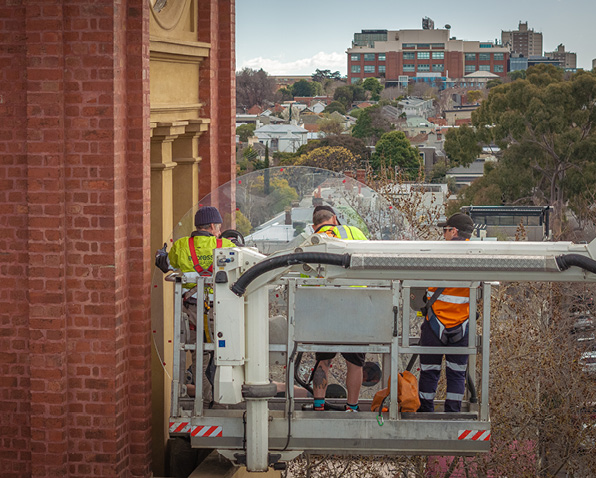
“A lot of my job for the clock tower was obtaining the required permits and approvals from Heritage Victoria to get the project underway, because there were multiple conditions that we had to fulfil. The glass had to be of a particular type, fragments of the original glass had to be retained, a precise methodology had to be provided – the list goes on.”
“It was challenging dealing with the work methodology, meaning how do we get a crane, where do we put the crane? How do we get the glass in through very narrow spots? That sort of thing,” says Joe. “A lot of things had to be taken into consideration, including the weather – we had to have it perfectly still and clear. Later in the springtime, Melbourne’s weather can be a bit unpredictable.”
There was also the matter of sourcing a horologist, aka a person that makes or repairs clocks and watches.
Enter Nigel Tonkin from Ingrams Time Systems, a Melbourne company that has been restoring, servicing and maintaining tower clocks in Australia since 1890. Nigel, who has worked as a horologist since the early ’90s, had the important task of disassembling, removing and then reassembling the clock hands and mechanism.
“I’ve worked on the Dimmeys Clock Tower a lot over the years, but the unique challenge of this job was the main problem was you had to remove the clock hands from outside the building, which is not the way we usually do it,” says Nigel. “So that means you’re working at height in a cherrypicker or a crane.”
Ingrams set aside a day to remove and a day to reinstall the clock mechanisms and clock hands (“They’re not that heavy – I believe they’re made of thin copper sheets over a brass backbone” says Nigel).
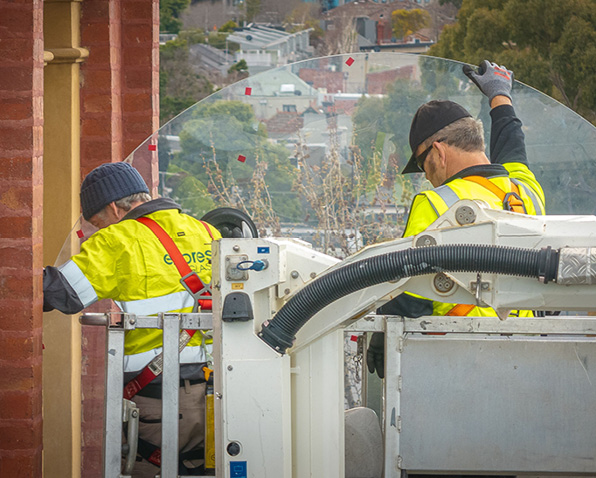
Proving it sometimes takes a village to ensure a job gets done properly, other contractors engaged for work included an electrician to keep an eye on wiring and a joiner to look after the glazing beads around the clock faces, which involved matching the original timber and bending it into a circle.
After 10 days and 45 hours of work from half a dozen Express Glass glaziers and numerous others, the finishing touch came from a signwriter employed to paint letters onto the clock faces (previously Roman numerals were used, but they were replaced by ‘DIMMEYSSTORE’ in the 1960s).
“The owners committee was definitely very impressed with the way the signwriting was done, which looks better than what was previously there,” says Tal Sahar, Managing Director of Owners Corporation Management company Tideways, who look after the Dimmeys building. “Obviously they used a certain type of paint and process back in the ’60s, but now the clock looks better lit up at night. It looks clearer and brighter and it’s more impressive than it used to be. So that’s a combination of the signwriter’s work, but also the glass that was used.”
Tal says that the Dimmeys clock tower is such a beloved icon in Melbourne that there would often be complaint calls from locals to the council asking when it would be fixed.
“That clock tower has a soft spot in a lot of people’s hearts, so it’s fantastic it’s back to its former glory,” says Tal. “We did a final walkthrough of the job with Express Glass in December 2024, and when you’re standing inside the clock tower, it definitely looks a lot better than what it did, but while still retaining its old heritage charm.”
Speaking of heritage charm: the removed southern clock face will get a second lease on life as a display item in the ground floor foyer of the Dimmeys building.
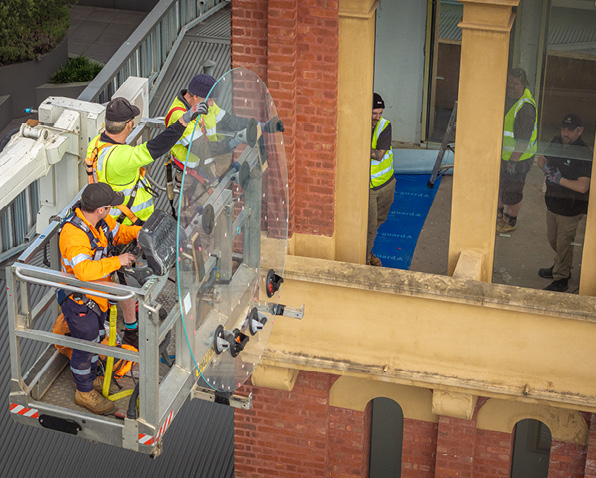
“We had to take extra care to ensure that when we took it out, that we kept it in one piece – all the glass components of the whole face were to be held, not thrown out,” says Wayne. “We couldn’t guarantee the glass would survive because it was so fragile that it could potentially break up into a million pieces, but it was successfully removed, put into storage and is now waiting for its comeback in the foyer.”
With the job now done and dusted, Tal says Tideways couldn’t be happier with the end result.
“Express Glass have been very patient throughout all of the planning of this job,” he says.
“When we engaged Express Glass, we had to think about who could potentially tackle a job this complex and big. The fact that we went to Express Glass in the first place is obviously a testament to your work.
“The Owners Corporation didn’t even entertain getting a second comparison quote, because they looked at all the effort that went into Express Glass preparing the first quote. I think you guys did really well in that regard and made it easy for the Owners Corporation.
“Ultimately, it’s a big thank you for a job well done.”