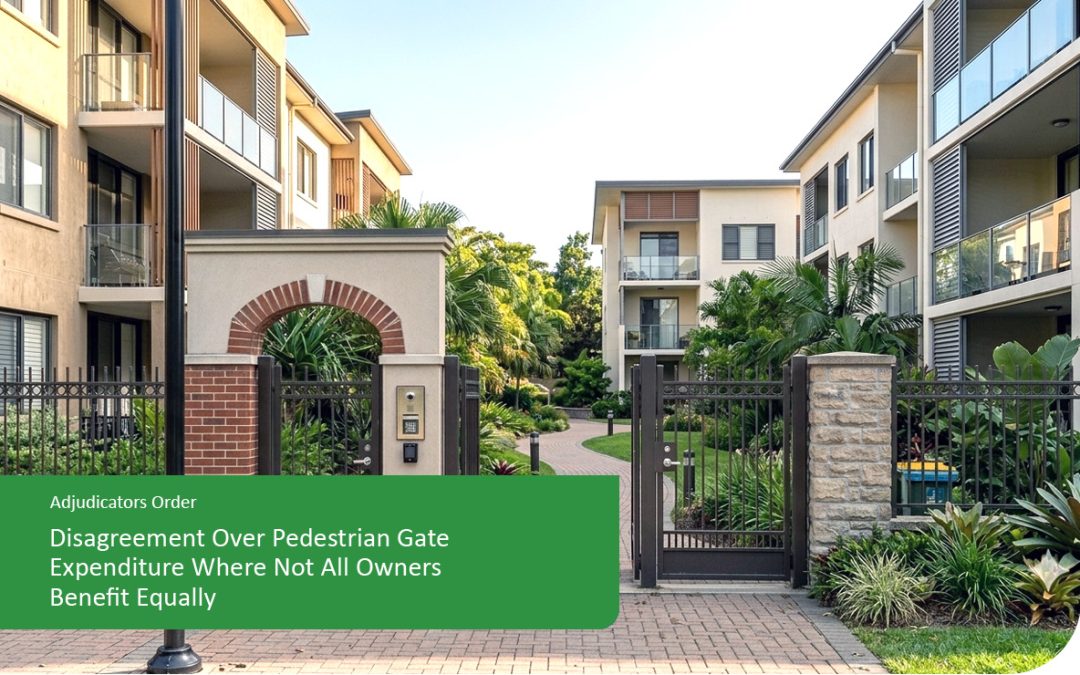
This month’s adjudication decision demonstrates the challenges that can arise when a body corporate decides to spend owners’ funds on an improvement to common property that, at first glance, appears to benefit only a limited number of lots within a scheme.
In Coterie at Windsor, the applicant lot owner challenged the installation of a pedestrian gate and fencing on the common property. The works were approved at a general meeting in December 2025 and funded from the body corporate’s sinking fund.
The applicant’s primary argument was that only five of the scheme’s eleven lots would receive a meaningful benefit from the new gate because those lots opened directly onto the walkway that the gate and fencing secured. The remaining lots were configured with their own individual gates and direct street access, meaning they derived little or no practical benefit from the improvement.
Background
The committee convened an extraordinary general meeting in December 2025, at which the proposed works were put to owners by ordinary resolution. The motion was carried and the works were subsequently completed.
Importantly, all owners were provided with access codes to the new pedestrian gate, and no exclusive use by-law was created in respect of the gated walkway. The area remained common property available for the use and enjoyment of all owners.
The applicant contended that the works should instead have required a resolution without dissent and argued that the owners of the five lots who received the greatest benefit should bear both the installation and ongoing maintenance costs.
In addition to the challenge regarding the pedestrian gate and fencing, the applicant also alleged that the committee had improperly relied on votes outside committee meetings for non-urgent matters and that the body corporate had failed to promptly address aesthetic maintenance issues affecting his lot. The adjudicator dismissed each of these arguments.
The Adjudicator’s Findings
The adjudicator found that:
- Section 186 of the Body Corporate and Community Management (Standard Module) Regulation permits a body corporate to make improvements to common property by ordinary resolution.
- The installation of the pedestrian gate and fencing did not amount to a disposition of common property and therefore did not require a resolution without dissent.
- Neither the Body Corporate and Community Management Act nor the Standard Module requires sinking fund expenditure to benefit every lot equally.
- The applicant failed to establish that the body corporate had acted unreasonably.
- Dissatisfaction with the outcome of a lawfully passed majority decision does not, of itself, establish that the body corporate has acted unreasonably.
Unequal Benefit Does Not Mean the Decision Is Unreasonable
In addressing the applicant’s principal complaint—that he received little or no direct benefit from the expenditure—the adjudicator made the following observations:
“It is not uncommon for a lot owner to express indignation where they do not receive a direct benefit from body corporate expenditure on a particular improvement. For example, a person on the ground floor of a tower building may object to the installation of a new lift because they receive limited benefit, if any, from such expenditure.
However, the common property is owned by all the owners of the lots ‘as tenants in common, in equal shares proportionate to the interest schedule lot entitlements of their respective lots’. Owners of lots in a scheme are entitled to beneficial use, including reasonable use and enjoyment of the common property at their discretion, even if they choose not to use certain parts of it.”
Key Takeaway
This decision serves as a useful reminder that improvements to common property do not need to provide an identical or equal benefit to every owner in order to be validly approved. The relevant question is whether the body corporate has acted within its legislative powers and made a reasonable decision.
Living in a community titles scheme inevitably involves balancing competing interests. While not every improvement will benefit every owner equally, that alone does not make the decision unreasonable or invalidate the expenditure. Community living, by its very nature, requires compromise.
If you want to read the case you can find it here: https://www.austlii.edu.au/cgi-bin/viewdoc/au/cases/qld/QBCCMCmr/2026/232.html.