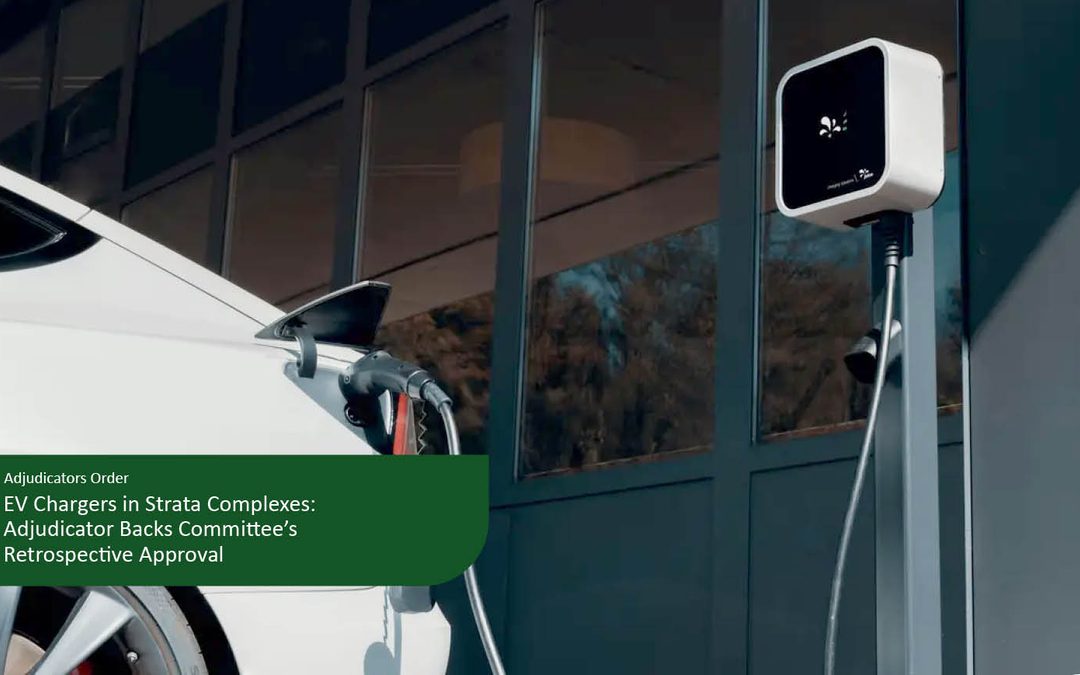
As electric vehicles (EVs) become more common on Australian roads, bodies corporate are increasingly navigating the legal and practical hurdles of installing charging infrastructure in shared residential buildings. A recent adjudication decision highlights how strata committees can reasonably manage retrospective approvals, safety concerns, and shifting committee policies regarding EV chargers.
The Background
The dispute centred on an EV charger installed in a basement car parking space within a residential complex.
- Initial Informal Approval: Years earlier, a lot owner (Owner A) approached the Body Corporate Committee and received “in-principle approval” to install an EV charger in their basement car space. However, formal approval was never granted at that time, and the charger had been operating since 2020.
- Policy Shifts in 2023: Following that initial nod, a subsequent Committee resolved in 2023 to pause any further EV lot improvements until a specialist report on the building’s fire suppression system could be obtained. Later that year, in December 2023, the Committee also resolved that any future EV charger installation motions should be put to a general meeting for all owners to vote on.
- Retrospective Approval in 2026: In 2026, Owner A formally applied for approval of their existing EV charger. By August 2026, the Committee considered the request and granted retrospective approval.
The Dispute
Another lot owner (Owner B) challenged the Committee’s decision, arguing that granting final approval to Owner A was improper. Owner B contended that the Committee’s decision:
- Breached earlier Committee resolutions made in 2023; and
- Was made before Queensland Fire and Emergency Services (QFES) released its official position on EV charging in car parks; and
- Was not in the best interests of the complex and set an irreversible precedent; and
- Failed to properly account for whether the basement’s fire safety suppression system was suitable for handling an EV fire.
The Committee’s Defence
In response to the challenge, the Committee outlined several practical and risk-based reasons supporting its decision:
- Proven Track Record: The charger had been operating safely without incident since 2020, and de-energising it would disrupt the established status quo.
- Fire Safety Assessment: A safety report commissioned by the Body Corporate rated the likelihood of an EV fire as “low” and confirmed that the basement car park was equipped with sprinklers.
- Insurance Clearance: The complex’s insurer conducted a risk assessment, closed its investigation without requiring the charger’s removal, and included EV charging conditions within the building’s policy.
- Owner Sentiment: At the 2024 Annual General Meeting (AGM), a motion proposed by an owner to stop the Committee from approving EV charger installations had been defeated.
The Adjudicator’s Decision
Ultimately, the Adjudicator ruled in favour of the Body Corporate and upheld the retrospective approval.
In reaching this conclusion, the Adjudicator noted that the independent safety report neither declared the basement car park unsafe for EV charging nor recommended that the existing charger be removed. Recognising that different individuals naturally have different tolerances for risk, the Adjudicator found that it was entirely open to the Committee to make the decision it did. Because Owner B failed to demonstrate that the Committee had acted unreasonably in granting retrospective approval, the application was dismissed.
Key Takeaways for Bodies Corporate
This decision serves as a useful reminder for strata committees and lot owners managing EV infrastructure requests:
- Reasonableness is Key: Adjudicators assess whether a committee’s decision is objectively reasonable based on the evidence available at the time, rather than substituting their own risk tolerance for that of the committee.
- Evidence Overcomes Speculation: Securing independent fire safety reports and consulting with the scheme’s insurer provides strong, objective backing for committee decisions.
- Past Policies Aren’t Permanent: Committees are generally not strictly bound by the policy resolutions of previous committees, especially when supported by updated safety assessments and broader owner sentiment at general meetings.
- Update your by-laws to provide an EV charger installation application must first be advised to the scheme’s insurer. Policies will change over time and it’s best to communicate and comply with what your insurance provider has to say.
If you want to read the case, you can find it here: https://classic.austlii.edu.au/au/cases/qld/QBCCMCmr/2026/388.html